
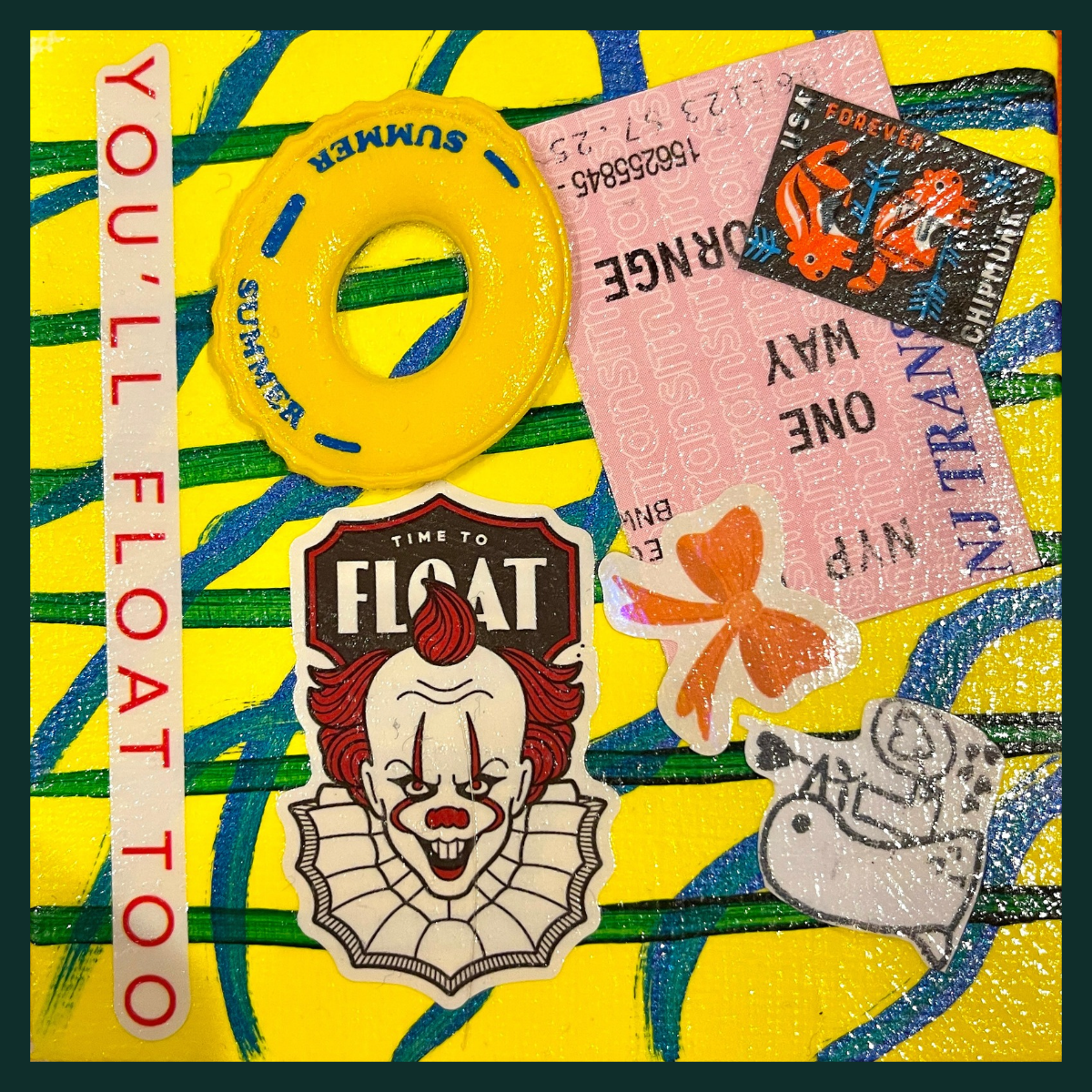
The best holiday of the year is quickly approaching. If you’re like me and love scary movies, you might recognize the line “You’ll float too” from “IT”, a movie based on Stephen King's novel. In honor of Halloween I crafted a collage featuring the petrifying Pennywise. I first painted my 4” x 4” canvas bright yellow, then painted green and blue squiggly lines on top of that. The final layer brings together a collection of little things that caught my eye. A used postage stamp I'd saved from the mail, a design made with a rubber stamp, a New Jersey Transit ticket stub, and a sticker in the shape of a bow. While searching for tiny items to fit the collage I stumbled upon a sticker sheet filled with beach essentials - sunglasses, ear plugs, a towel, and a life preserver. When I spotted that, I knew I had to include it. Against the backdrop of “IT”, the donut shaped floatation device was too perfect to leave out. And then there's the sticker that ties it all together: “You'll float too.”
A collection of random things
Each object that makes up this art may look totally random. And for the most part, they are. I keep brochures, magazines, and catalogs, the paper that chopsticks come in, anything that could help build interest in a piece. Some have a story attached. The train ticket is from a trip I took last month to the Midwest. The NJ transit was one leg of a journey that included two buses, a train, an AirTrain, a plane and a car.
Some things I collect simply because I like them. Take the cutout of the smiling Raisin Bran sunshine holding two scoops of raisins (two scoops in each bowl if I am remembering the ad correctly.) I chose several of the items mainly because they were small enough to fit on the tiny canvas.. Once they're all on the canvas they work together to create art. The overarching theme is “IT” and the secondary theme is travel. The life preserver floats down water. The train moves from city to city. This particular postage stamp traveled from Ohio to New York. And the bow - that’s near the center conveniently wrapping it all up nice and tidy.
Art collages are similar to knowledge bases
This got me thinking about knowledge bases (KB) and how we organize information. Organizations keep information scattered across documents, emails, shared drives, and the minds of the people who work there. Sometimes, you have to look a little closer to see why the pieces belong together. It may not be obvious at first. There may be a thru-line that we don’t notice until we dig a little deeper.
I know why each piece of this collage is there, but someone else might look at it and see a collection of unrelated objects. The connections make sense to me because I know the stories behind them. The same thing happens with KBs. The person who builds one knows how the information is organized and where things belong. But the person searching for an answer may not know that logic. They just know what they're looking for.
A lot of the time, information is grouped according to the department that created it. That seems logical enough. Marketing has campaign briefs and brand guidelines, sales has pitch decks and client proposals, and product has feature specifications and release notes. But what happens when the sales team needs something that lives in the marketing section? Or when customer service needs an answer that's buried in a technical document? The information is there. It just might not be where someone would think to look for it. When I’m developing the information architecture for a knowledge base, I think about who needs the information, what they're trying to accomplish, and how they're likely to look for an answer. Those questions don't always line up neatly with an organization's departmental structure.
Whether you're assembling a collage or building a knowledge system, the pieces are only the beginning. When you step back and look at the whole picture, you can then see why certain documents are organized the way they are. It might make sense to the person who has structured the CMS. But it could also appear in total disarray to the person who needs to locate and use the shared information.
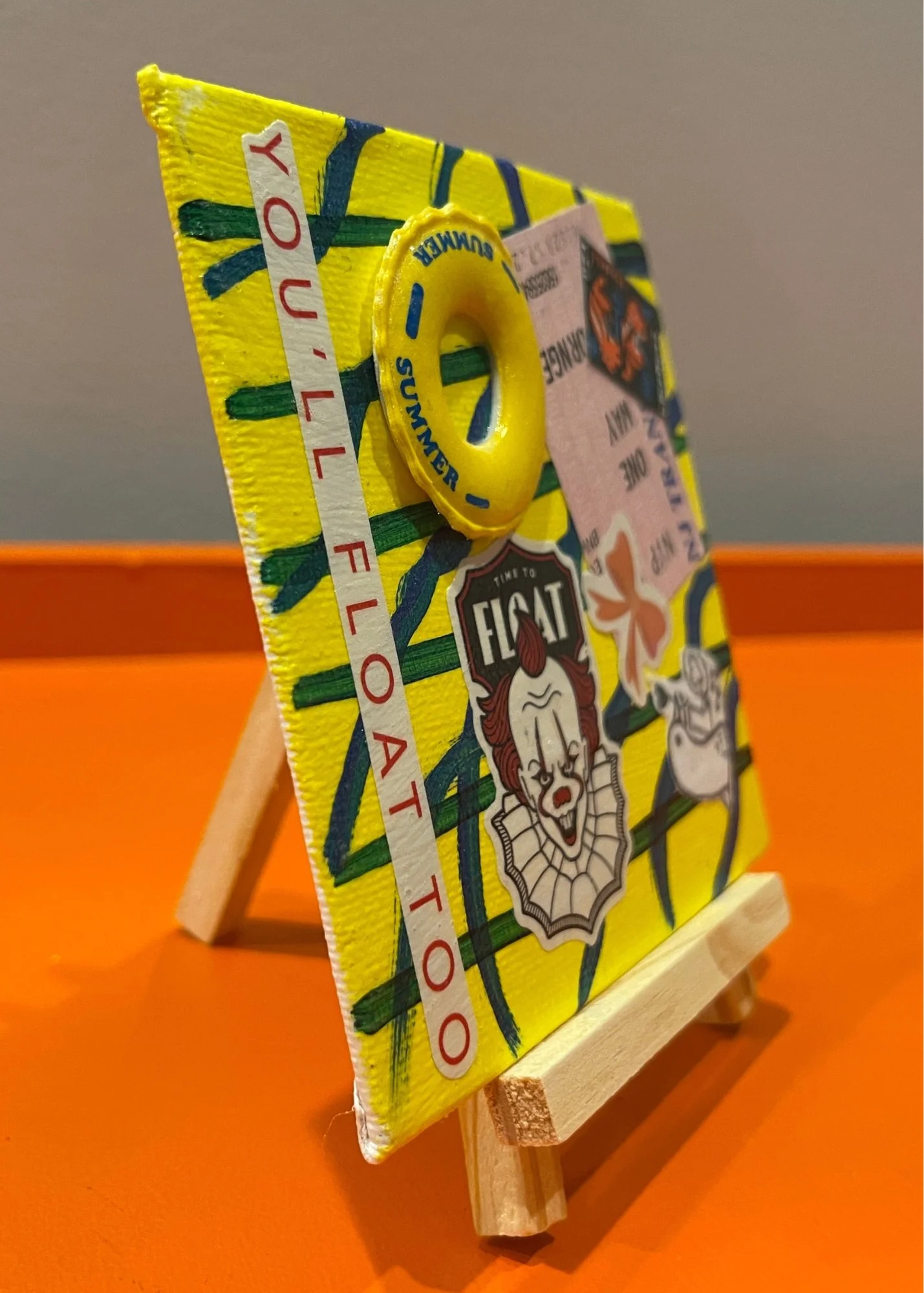
The 4”x4” art collage sits on a tiny easel.
The search function
Adding tags and metadata to knowledge base articles is crucial to ensuring-say it with me-“the right people can locate the right information at the right time.”
Search can be especially useful when employees need information that lives outside their own department. AI-powered tools like Glean can help employees find relevant documents across different sources. Providing context about what they're trying to accomplish can help the tool identify information that might otherwise be overlooked. But search is only as useful as the information it has to work with. Documents need meaningful titles, useful tags and metadata, and, just as importantly, someone needs to keep the content current. Finding a document isn't enough if an employee can't tell whether it's the most updated version.
Who takes responsibility for maintaining that information depends on how the organization is structured. A knowledge management (KM) team might establish the standards and oversee the process, or individual content owners might be responsible for keeping their contributions accurate. It is essential to create governance standards.
The goal is to make it easy for employees to find information they can use, without having to know which department created it or where it lives in the knowledge base. When people can find the right information and trust that it's current, they can spend less time searching and more time getting their work done.
Can you and your staff easily locate what you need? If not, let’s talk. We’ll explore your situation and discuss how I can help make the information you already have work for you. ✨
